

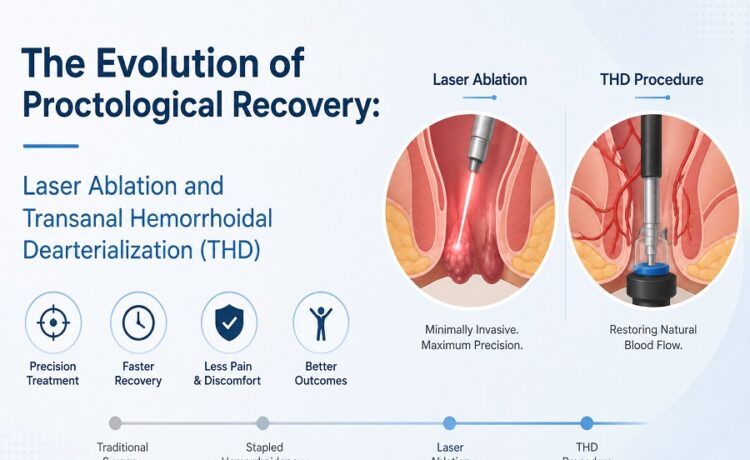
Haemorrhoids are one of the most common colorectal disorders globally, affecting millions of adults at some point in their lives. Characterized by the inflammation, swelling, and displacement of the normal vascular cushions within the anal canal, this condition can cause chronic bleeding, severe discomfort, and a significant drop in a patient’s overall quality of life. Despite how common it is, a deep-seated fear of painful treatments often causes individuals to delay seeking care, allowing internal or external haemorrhoids to progress to advanced, debilitating stages.
Historically, this fear was somewhat justified. The traditional gold-standard surgical option—the conventional open or closed excision haemorrhoidectomy—involves physically cutting away the vascular tissue. Because the perianal region is dense with sensitive nerve endings, this classic procedure is notorious for causing intense post-operative pain, requiring lengthy hospital stays and extended recovery periods. However, advanced colorectal medicine has experienced a significant technological shift. Through the deployment of ultra-precise laser ablation and Transanal Hemorrhoidal Dearterialization (THD), the top hospitals in dubai have rewritten the recovery timeline, replacing painful tissue excision with sophisticated, tissue-sparing options.
The Mechanical Root: Understanding Haemorrhoidal Vascularity
To understand why modern treatments are so effective, one must look at the underlying vascular architecture of the rectum. Haemorrhoidal cushions are normal anatomical structures composed of highly vascular connective tissue, smooth muscle, and direct connections between arteries and veins (arteriovenous anastomoses). They act as natural valves that assist with bowel control.
Clinical issues arise when the supportive connective tissue matrix degrades due to chronic straining, elevated intra-abdominal pressure, or natural aging. As this support weakens:
-
The vascular cushions engorge with blood and stretch abnormally.
-
Internal cushions begin to slip down (prolapse) through the anal sphincter.
-
Terminal branches of the superior rectal artery continue to pump blood into these weakened cushions under high pressure, causing chronic bleeding and preventing the tissue from shrinking naturally.
Advanced proctological care focuses on resolving this mechanical problem by targeting the blood supply or gently shrinking the tissue, avoiding the need to cut sensitive mucosal layers.
Transanal Hemorrhoidal Dearterialization (THD): The Precision Ligating Approach
Transanal Hemorrhoidal Dearterialization represents a major advancement in minimally invasive proctology. Instead of surgically removing the swollen tissue, THD systematically targets the underlying cause of the condition: the arterial blood flow.
The Step-by-Step THD Procedure:
-
Doppler Localization: The colorectal specialist inserts a specially engineered, high-definition anoscope equipped with a miniature Doppler ultrasound probe. This probe allows the surgeon to listen to the blood flow and locate the exact terminal branches of the superior rectal artery supplying the haemorrhoid.
-
Targeted Ligation: Once a target artery is identified, the surgeon applies a precise micro-suture through a dedicated window in the anoscope, tying off the blood vessel. This instantly reduces the high-pressure blood flow into the vascular cushion.
-
Haemorrhoidopexy: If the patient has prolapsed internal tissue (Grade II or Grade III), the surgeon performs a “pexy.” This process uses sutures to lift the dropped mucosal tissue back up to its original, healthy anatomical position above the dentate line.
Because the entire THD process takes place above the dentate line—a region of the rectum that lacks somatic pain receptors—patients experience almost no sharp pain after the procedure. Over the following days, the lack of arterial blood flow causes the swollen cushions to naturally shrink and transform into flat scar tissue.
Laser HaemorrhoidoPlasty (LHP): The Power of Photothermal Ablation
For patients seeking an even more streamlined recovery, laser ablation (often referred to as Laser HaemorrhoidoPlasty) utilizes specialized fiber-optic light energy to neutralize haemorrhoidal tissue from the inside out.
The Mechanism of Laser Ablation:
Rather than altering the surface mucosa, the surgeon creates a tiny, sub-millimeter entry point near the base of the cushion. A thin, flexible glass fiber connected to a calibrated diode laser is inserted directly into the center of the vascular mass.
When the laser is activated, it delivers a precise burst of photothermal energy. This energy causes immediate coagulation within the vascular tissue, closing the internal blood vessels and collapsing the cushion without damaging the delicate surface skin or the underlying anal sphincter muscles.
This structural protection eliminates the risk of post-operative open wounds, radically reduces the risk of infection, and allows the body’s natural healing systems to absorb the collapsed tissue smoothly over a few weeks.
Traditional Haemorrhoidectomy vs. Advanced THD and Laser Ablation
|
Evaluation Metric |
Conventional Excision Surgery |
Doppler-Guided THD |
Laser Ablation (LHP) |
|
Surgical Approach |
Cutting and removing tissue |
Target arterial ligation |
Sub-mucosal thermal shrinking |
|
Post-Operative Pain |
High (Requires heavy analgesics) |
Minimal (Vague pressure feeling) |
Very Low (Mild aching) |
|
Risk of Open Wounds |
Yes (Requires weeks of packing) |
None |
None |
|
Sphincter Damage Risk |
Present (Risk of long-term leaks) |
Zero |
Zero |
|
Return to Regular Work |
2 to 4 weeks |
2 to 4 days |
1 to 2 days |
Choosing Advanced Care: Selecting the Best Clinical Infrastructure
Because both THD and laser ablation require highly specialized, expensive equipment and advanced micro-surgical training, these therapies are not universally available at every neighborhood medical center. Achieving a safe, permanent recovery depends heavily on selecting a premier provider from the top hospitals in dubai.
A highly accredited hospital facility ensures that your proctological journey is guided by comprehensive pre-operative diagnostics—including high-definition video proctoscopy—to confirm that your specific grade of haemorrhoids is ideal for these advanced methods. Furthermore, these top-tier institutions provide a sterile, state-of-the-art operating infrastructure and experienced colorectal specialists, ensuring that your treatment is handled with the highest level of professional care and clinical safety.
Conclusion: Embracing the Future of Colorectal Wellness
The evolution of proctological care demonstrates how advanced medical technology can reshape a patient’s recovery experience. Suffering in silence due to the fear of a painful operation is no longer necessary.
By replacing traditional, tissue-cutting surgeries with advanced solutions like Doppler-guided THD and laser ablation, modern medicine has made resolving chronic haemorrhoids a straightforward, manageable process. When handled within a premier medical facility, these advanced, tissue-sparing techniques allow patients to step away from short-term topical treatments, fix the vascular issue at its source, and quickly return to a comfortable, active life with minimal downtime.

